How Long Should a Recruitment Agency Spend Reviewing a New CRM?
For a mid-market recruitment agency, a CRM review should usually take 60-90 days. Long enough to test fit properly, short enough to keep momentum.
Written by Harry Whysall, Account Executive at Imagine AI. 7 years in recruitment tech selling a variety of solutions to scaling agencies.
Quick answer: For a mid-market recruitment agency (10-50 staff), reviewing a new CRM should take 60-90 days. Less than that, and agencies tend to skip the steps that prevent a bad fit. More than that, and momentum dies, and most end up renewing with the system they'd already decided wasn't working.

The two ways agencies get this wrong
After years of sitting on both sides of this process, as a recruiter and as the person selling the technology, the same two failure modes come up again and again.
Too fast. An agency rushes the decision, often to beat a contract renewal date. They skip technical demos, never build a proper business case, and go live without the team really understanding what they're getting. Functionality problems and adoption issues follow almost immediately.
Too slow. An agency drags the process past 90 days. Sessions stretch weeks apart, stakeholders go quiet, and momentum disappears. Without realising it, the agency talks itself out of a decision it had already made, and ends up renewing with the current provider by default, not by choice.
Both outcomes lead to the same place: an agency stuck on a system it already knows isn't right for them.
Why 60-90 days is the sweet spot
Sixty to ninety days gives a mid-market agency enough time to properly evaluate a new CRM, without losing the momentum and energy that gets a project over the line. It's long enough to be thorough. It's short enough that people stay engaged.
This isn't a hard rule. A very clear, well-run process can move faster, and a genuinely complex project can justify running longer. But across mid-market agencies (10-50 heads), 60-90 days is consistently where it lands when the process is run properly.
What a proper 60-90 day review actually looks like
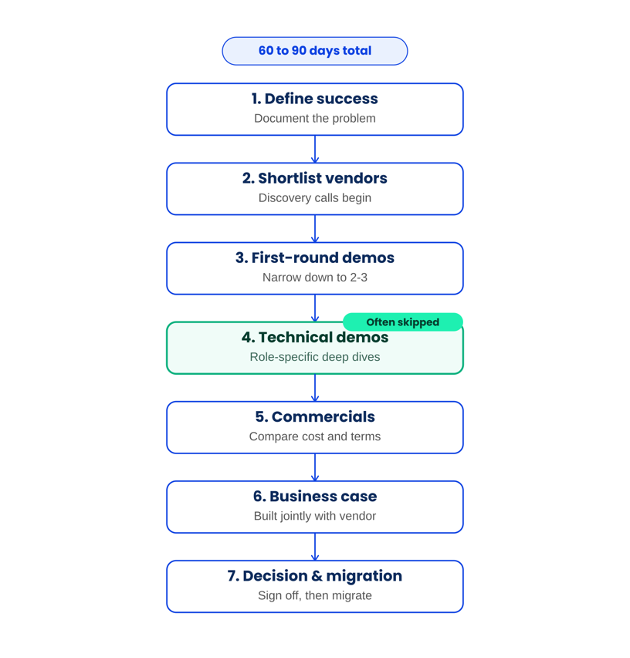
1. Define what success actually looks like
Before anything else, document what isn't working today, where it's holding the business back, and what specifically needs to change. This is also where most agencies need to confront a hard truth: changing CRM will be disruptive, during procurement, during data migration, and again post-go-live while the team adapts. Naming that disruption upfront, rather than pretending it won't happen, is what makes the rest of the process honest.
2. Shortlist 4-6 vendors and run discovery calls
Start broad. A discovery call lets each vendor understand what you actually need, and lets you understand how (or whether) they map to your goals.
3. First-round demos: narrow to 2-3
High-level demos at this stage are about capability and fit: does the UI/UX work for your team, and is there an obvious reason a vendor doesn't fit? This is where 4-6 vendors should become 2-3.
4. Technical, role-specific demos
This is the stage that gets skipped most often, and it's the most important one. Bring in the team and split demos by function: perm desk, contract/temp desk, compliance, back office. A vendor should be specific to your data and your workflows by this point, showing exactly how each part of the business is handled today and how it improves.
5. Commercials and a like-for-like comparison
Compare pricing side-by-side across vendors and against your current setup, including any other tools in your stack the new system would replace (automation, data enrichment, compliance tools). Check contract terms, usage limits, and built-in price rises here too, not after signing.
6. Build the business case together
Work with your preferred vendor(s) to map out expected ROI. If you're the stakeholder taking this to the board, you need a case that's clear and mutually built with the vendor, not one they are constructing alone after the fact. Without that, getting sign-off to leave your current system becomes very difficult.
7. Decision, contract, and migration planning
Final negotiation, sign-off, and a clear view of what the migration effort actually involves.
What goes wrong if you rush it (under 60 days)
Skipping steps to move fast usually means no technical demos, no proper business case, and no clear agreement internally on what success looks like. The most common result: functional gaps and adoption problems after go-live, because the system was never tested against how the team actually works. It's often driven by trying to switch before a contract renewal date, a deadline that shouldn't be allowed to compress the whole process.
What goes wrong if it drags on (over 90 days)
Going past 90 days isn't automatically a problem, if there's a clear reason: a more complex project, more to see from vendors, more to validate. The issue is when an agency can't explain why it's still in the process. That's usually a sign the project was never fully real to begin with, or that senior stakeholders were never properly bought in.
The longer it drags, the more momentum erodes: gaps between sessions grow, stakeholders become harder to pin down, and doubt creeps in. Fear of getting the decision wrong builds the longer it sits unresolved, and that fear makes switching feel riskier than staying put, even when staying put was the worst option all along.
The one rule that keeps a review on track
Run each stage in the same week, and keep no more than five working days between vendor demos. If two weeks pass between the first vendor's demo and the last, it becomes genuinely difficult to compare them fairly: details blur, impressions fade. Push vendors to align to your timeline, not the other way around. A tight, consistent cadence is what keeps the whole process, and the final decision, clear-headed.
Review cadence
"Run each stage in the same week, and keep no more than five working days between vendor demos"
Quick answers
Is 60-90 days too long to spend reviewing a CRM?
No. For a 10-50 person agency, it's the range that consistently produces a confident decision without losing momentum. Shorter is fine with a very clear process already in place; just be sure you can explain why you're moving faster.
What if our current contract renews before we finish reviewing?
Don't let the renewal date compress your process. A rushed decision to beat a deadline is one of the most common causes of post-go-live problems.
How many CRM vendors should we shortlist?
Start with 4-6 for initial discovery calls, then narrow to 2-3 after first-round demos based on capability and UI/UX fit.
What's the biggest reason agencies stay on a CRM they don't like?
The review process drags past 90 days, momentum disappears, and renewing with the current provider becomes the easiest decision, even after the agency had already concluded it wasn't the right fit.