Why a Recruitment Agency Should Change Its CRM
A recruitment agency should change CRM when the move has a clear strategic benefit, saves money, enables growth, or closes a technology gap.
Written by Harry Whysall, Account Executive at Imagine AI. 8 years in recruitment tech, including time selling CRM and automation tools to scaling agencies.
Quick answer: A recruitment agency should change its CRM when it can clearly identify a strategic benefit from doing so, when staying on the current system is measurably costing more than switching, when the agency has outgrown what the platform can support, or when the product has failed to keep pace with technology while prices have continued to rise. The test is simple: if you can articulate specifically how a move makes the business more money, saves the business money, or enables growth that the current system cannot, the case for change is probably strong enough.
The right reason to change
The starting point for any CRM change should be a clear sense that you can achieve significantly more by making the move. Not a vague sense that something better must exist, but a specific understanding of what better looks like for your agency and why the current system is preventing you from getting there.
Every reason covered in this post comes back to that principle. If you can map the change to a concrete business outcome, the case is real. If you cannot, revisit the reasons not to change first.
Five reasons to change your CRM
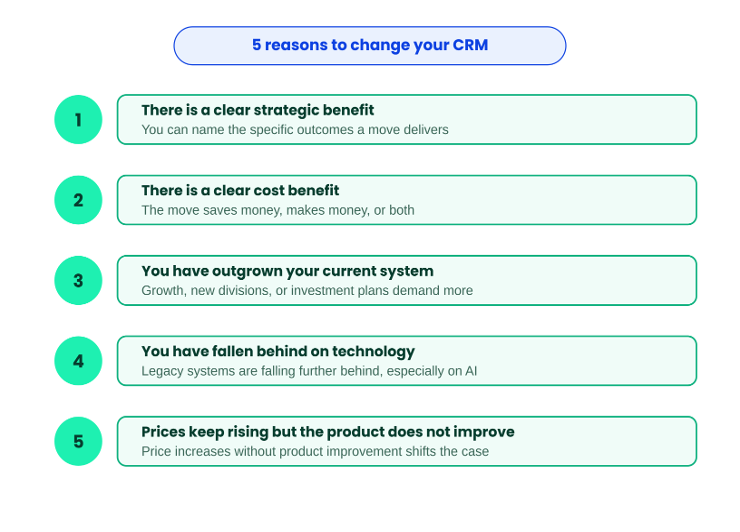
1. There is a clear strategic benefit to making the change
A clear strategic reason to change is not a feeling that the grass is greener. It is the ability to point to specific outcomes that a move would deliver for the business.
Those outcomes might include bringing in more revenue per consultant, reducing time-to-fill on open roles, increasing productivity across the team, maintaining higher standards of candidate and client management, or providing a meaningfully better experience to the people your agency serves. Any one of these is a legitimate strategic reason to move, provided it is specific enough to measure and strong enough to justify the disruption involved.
The clearest signal that a strategic case exists is when your current CRM is not directly contributing to revenue at all, when it is not helping consultants do their jobs more effectively, or when you feel the business is falling behind the pace of the market and the system is part of the reason why. If you can answer the question what does success look like after we change with something specific and measurable, you have a strategic case.
2. There is a clear cost benefit
Any system you move to should do one of two things: save the business money or help it make more money. Ideally both. If neither is true, the financial case for change does not exist.
Cost benefit in a CRM change can come from two directions.
The first is consolidation. Many agencies are running a patchwork of separate tools: a CRM, an outreach platform, a data enrichment tool, an automation solution, a compliance product. If a new platform consolidates several of these into one, the cost saving across the stack can be substantial, and the reduction in operational complexity is a benefit in itself.
The second is revenue. If your current system does not allow you to consistently reach out to warm candidates and clients at the right time, does not surface the right people at the right moment, and does not give consultants the signals they need to stay front of mind, revenue is leaking.
If you can clearly demonstrate that a move either reduces cost or increases revenue per head, the financial justification for change is in place.
3. You have outgrown your current system
Smaller agencies can often manage with a simpler or less capable platform. Relationships carry a lot, and cost efficiency at an early stage makes sense. But as an agency grows, the demands placed on its CRM grow with it.
There are several specific points at which an agency tends to outgrow its current system. Expanding into contract or temporary staffing from a permanent base typically exposes gaps in compliance capability and back office functionality. Adding consultants who come from larger agencies brings new expectations around tooling. Taking on new divisions or markets creates data management and workflow complexity the current system was not built for.
If any of these apply, and the current CRM is creating friction rather than enabling growth, that is a meaningful reason to change.
There is also a longer-term commercial dimension. Agencies looking to attract external investment or position themselves for acquisition benefit from having robust, modern systems in place. A well-structured tech stack demonstrates operational maturity and makes it significantly easier to evidence the contribution the business technology is making to its performance. As acquisition rates across the recruitment sector have become more competitive, this has become a more relevant factor than many agency owners realise.
4. You have fallen behind on technology, particularly AI
Legacy systems are falling behind at an accelerating rate. The pace of AI development over the last two years has created a growing gap between what modern platforms can offer and what older systems are capable of. If your agency is on a legacy CRM, that gap is only going to widen.
As covered in the previous post in this series, wanting AI is not by itself a reason to change. But being able to identify specific AI capabilities that would meaningfully change how your consultants work is a genuine reason to move.
The distinction worth drawing is between AI as an assistant and AI as an agent. AI assistance surfaces information, reformats content, and suggests next actions. Agentic AI goes further: it takes direction and acts on it, completing tasks that would otherwise consume consultant time. If you can map agentic AI capability to time saved or revenue generated, and your current system cannot offer it, that represents a real and growing competitive disadvantage.
Falling behind on technology is a slow process that tends to be underestimated until the gap becomes difficult to close. Addressing it before it becomes critical is significantly easier than addressing it after.
5. Your prices keep rising but the product is not improving
Price increases are a standard part of any SaaS agreement, and they are not by themselves a reason to change. A vendor whose product is meaningfully better at the end of a three-year contract than it was at the start has earned a price increase.
The signal to watch for is the combination: prices rising while the product stagnates. If your current vendor is not keeping pace with the market, is not releasing features that reflect how modern recruitment works, and is not addressing the gaps your team experiences day to day, then a price increase on that static product shifts the cost-benefit calculation significantly.
The question to ask at renewal is not just what the new price is, but what is materially better about the product today compared to when you last signed. If the honest answer is very little, and better alternatives exist at a similar or lower price point, the case for change is straightforward.
The two tests for whether to change
Every reason above comes back to the same two questions. Can this move make the business more money or save the business money? And is the gap between what we have and what we could have large enough to justify the disruption of switching?
If both answers are yes and you can back them with specifics, change. If either answer is no or uncertain, read the previous post in this series first.
Case for change
"If you can map the change to a concrete business outcome, the case is real."
Quick answers
How do I know if the strategic case for changing CRM is strong enough?
If you can answer the question what does success look like twelve months after going live on a new system with something specific and measurable, the strategic case is likely strong enough. If the answer is still general or vague, it is not.
Is consolidating our tech stack a good reason to change CRM?
Yes, if the consolidation delivers a genuine cost saving and does not remove capability your team depends on. Map your current stack, identify what a new platform replaces, and check that nothing operationally critical disappears in the process.
Should we change CRM if we are planning to grow headcount significantly?
If your current system is already creating friction at your current size, almost certainly yes. Systems that are barely adequate for twenty consultants tend to become serious blockers at thirty or forty. Getting the right platform in place ahead of a growth phase is significantly easier than doing it during one.
Does being on a legacy system justify switching?
It depends on the gap. If the legacy system is preventing specific outcomes the business needs, and modern alternatives can deliver those outcomes, yes. If the legacy system is functional and the gap is not yet affecting performance, it may not be the right moment.
What if our current vendor raises prices but the product is still decent?
Price rises alone are not a reason to change. The question is whether the product improvement justifies the increase. If it does, renewing is probably the right call. If the product has stayed broadly the same while the price has increased materially, that changes the cost-benefit calculation and a review is warranted.