Why a Recruitment Agency Should Not Change Its CRM
A recruitment agency should not change CRM until it can define success, diagnose adoption issues, align internally, and prove the market offers a better fit.
Written by Harry Whysall, Account Executive at Imagine AI. 8 years in recruitment tech, including time selling CRM and automation tools to scaling agencies.
Quick answer: A recruitment agency should not change its CRM if it cannot clearly define what a successful move looks like, if internal adoption is low for reasons unrelated to the system itself, if the issues driving the review are minor rather than business-critical, or if no solution on the market is tangibly better than what the agency already has. Changing CRM is disruptive and expensive. It should only happen when the case for change is clear, agreed internally, and specific.

The problem with window shopping
A large proportion of agencies go out to market believing there is something better available, without being able to define what better actually means for them.
There is no shortage of talented software vendors, and there is always a flashy feature or a polished demo to get excited about. What is rarely done well enough before starting that process is defining success. Without that, agencies end up in rounds of demonstrations that consume significant time and energy, only to renew with their current provider or make a move they later regret.
These are the most common reasons an agency should not change its CRM.
Seven reasons not to change your CRM
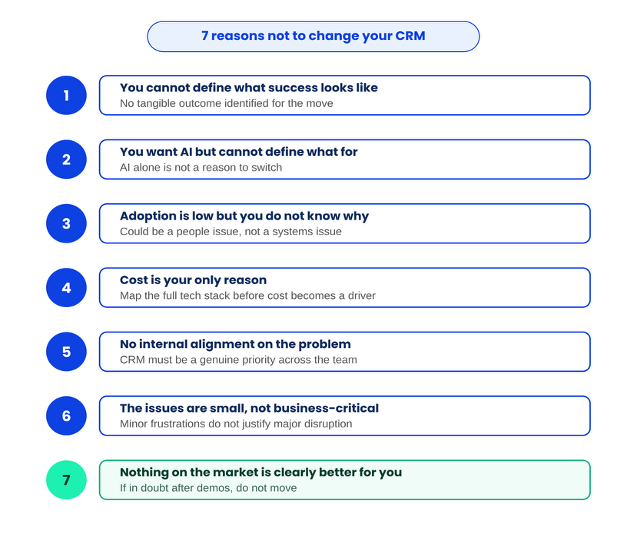
1. You cannot define what success looks like
If you cannot quickly and decisively answer, as a team, what you need to get out of a move, you are probably on the right system already, or there is not enough urgency to justify the disruption of changing.
Wanting something better, wanting a system consultants will enjoy using, or wanting more out of the platform are not definitions of success. They are directions of travel. A tangible definition of success means being able to point to specific qualitative or quantitative outcomes: a reduction in time spent on a given task, an improvement in time-to-fill, a consolidation of tools that is costing the business money.
Every vendor you speak to will tell you they significantly increase revenue, reduce time-to-fill, and lead on AI. Every single one. The only protection against being swayed by that is entering those conversations already knowing what you specifically need to achieve, and being able to map vendor claims back to those outcomes.
If you cannot do that, do not start the review.
2. You want AI, but cannot explain what you need it to do
AI is now a feature of almost every CRM on the market. Saying you want a system with AI does not describe a problem, and it is not a reason to change.
There are meaningful differences between the types of AI now available: surface-level querying, MCP integration, AI assistance, and agentic AI. Each does something different. Each has a different impact on how consultants work, and a different ROI profile.
AI typically has a high adoption rate but, at this stage of the market, a lower return rate than most vendors will admit. Before AI becomes a reason to change your CRM, you need to be able to say specifically what the AI will do, how it will affect your consultants, clients, and candidates, and how it maps to your strategic goals as a business.
If you cannot answer that, AI is not yet a reason to move.
3. Your adoption is low but you do not know why
Low adoption of your current CRM is often cited as a reason to change. It is rarely that simple.
Low adoption can be a sign that the system is genuinely poor. But in the majority of cases it reflects something else entirely: a lack of clear business priority around the platform, or a lack of buy-in from consultants who do not see how the system enables their role.
If you move to a new CRM without understanding why adoption is low, you will very likely have the same adoption problem within six months of going live on the new platform. The system changes. The underlying problem does not.
Before starting a review, investigate the adoption issue first. Is this a systemic business problem, or is it genuinely a systems problem? Once you can answer that clearly, you are in a much stronger position to make the right decision.
4. Cost is your only or primary reason
Cost is a legitimate consideration in any CRM review, but it is rarely sufficient on its own as a reason to change.
Understanding your current tech stack cost is essential before you start. No agency in this market should be buying a simple CRM in isolation. The real cost question is what the new system consolidates, what it replaces, and whether the removal of any existing tools creates a gap that negatively impacts how consultants do their jobs.
If a new system is cheaper but requires replacing a data enrichment tool, an automation platform, or a compliance solution that your team relies on, the net cost comparison shifts significantly. Map the full picture before cost becomes a driver for change.
5. There is no internal alignment on the problem
A CRM review will involve significant change management. It will absorb time from leadership, operations, and the consultant team. For that to be worthwhile, the CRM needs to be high on the business priority list, and that priority needs to be agreed across the team, not just felt by one person.
If different stakeholders within the business cannot agree on what the core problems are, or if the CRM is one of several competing priorities that are all being treated as equally urgent, the review process will stall. Momentum will drop, demonstrations will stretch out, and the project will quietly die without a decision being made.
This is one of the most common reasons agencies end up renewing with a provider they have already concluded is not right for them. Not because the decision was wrong, but because the internal conditions for making a good decision were never in place.
Align internally first. Define the top priority. Then start the review.
6. The issues you have are small rather than business-critical
A slightly higher renewal price, a feature available in a competitor system, a support response that was slower than expected: these are not reasons to change CRM.
The disruption of a CRM switch, including procurement, migration, training, and the adoption curve post go-live, needs to be justified by problems of equivalent scale. Small issues do not create enough momentum to carry a project through to a good outcome, and they do not create enough buy-in from the team to sustain engagement across a long review process.
If the list of reasons to change is a collection of minor frustrations rather than genuine business blockers, the time and resource spent on a review would almost certainly deliver more value directed elsewhere.
When the issues are large enough that staying put is actively costing the business, that is the right time to move.
7. Nothing on the market is clearly better for you
If you have been through demonstrations and found yourself hesitant, or if the leading options each have a similar number of pros and cons against your current system without a clear differentiator, it is probably not the right time to move.
A successful CRM switch requires genuine conviction in the new platform, from leadership and from the consultants who will use it every day. If the gap between your current system and the alternatives is not significant enough to generate that conviction, adoption after go-live will be harder to achieve, and the disruption of the change will be much more difficult to justify.
If after a thorough review no system is tangibly better for your specific needs, renewing with your current provider and revisiting in twelve to eighteen months is the right call.
Decision discipline
"Changing CRM should only happen when the case for change is clear, agreed internally, and specific."
Quick answers
Should I change my recruitment CRM if my team is not using it properly?
Not necessarily. Low adoption is often a people or process problem rather than a system problem. Before starting a review, understand why adoption is low. If the root cause is internal, moving to a new system will not solve it.
Is wanting AI a good reason to change CRM?
Only if you can define specifically what the AI needs to do and how it maps to your business objectives. AI is now a standard feature across most platforms. Without a specific use case, it is not a differentiating reason to change.
What if our CRM is just more expensive than competitors?
Cost alone is rarely sufficient reason to switch. You need to account for the full tech stack, including what the new system replaces and whether any removals create operational gaps. Map the total cost picture before making cost a driver.
How do I know if my issues are big enough to justify changing?
Ask whether staying on your current system is actively blocking a specific business objective. If the answer is yes and you can articulate how, the issues are probably significant enough. If the answer is a collection of minor frustrations, they probably are not.
What should I do if I have been through demos and nothing stands out?
Pause the review. If no system is tangibly better than your current platform for your specific needs, the disruption of switching is not yet justified. Revisit in twelve to eighteen months with clearer criteria.